


The Science Behind Taste Perception: How the Tongue Detects Different Flavors
How the Tongue Tastes Different Flavors ?

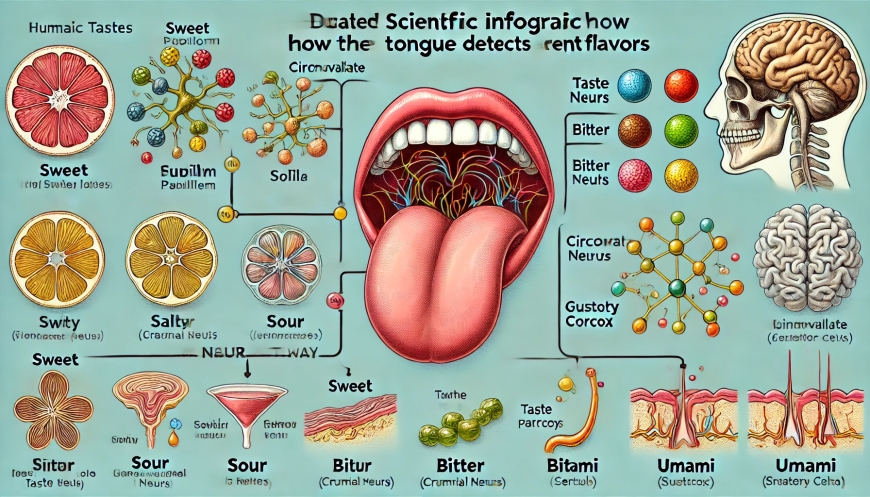
Taste perception is a complex physiological process involving the interaction of chemical compounds with specialized sensory receptors located on the tongue. This process is mediated by the gustatory system, which includes taste buds, receptor cells, neural pathways, and brain regions responsible for interpreting taste stimuli.
1. The Five Basic Tastes and Their Mechanisms
The human tongue is capable of detecting five fundamental taste modalities, each associated with specific chemical stimuli and receptor mechanisms:
1.1 Sweet
-
Stimuli: Sugars (e.g., glucose, fructose, sucrose), artificial sweeteners (e.g., aspartame, saccharin).
-
Mechanism: Sweet taste perception is mediated by G-protein-coupled receptors (GPCRs), specifically the T1R2/T1R3 heterodimer, located on taste receptor cells. These receptors activate intracellular signaling cascades via gustducin, leading to neurotransmitter release and signal transmission to the brain.
1.2 Salty
-
Stimuli: Sodium (Na⁺) and other cations (e.g., K⁺, Li⁺).
-
Mechanism: Salt taste is detected through epithelial sodium channels (ENaCs), which allow sodium ions to enter taste cells, causing depolarization and triggering neurotransmitter release.
1.3 Sour
-
Stimuli: Hydrogen ions (H⁺) from acidic substances such as citric acid or acetic acid.
-
Mechanism: Sour taste is mediated by acid-sensing ion channels (ASICs) and proton-sensitive potassium channels, which detect changes in pH and ion concentration, leading to taste cell activation.
1.4 Bitter
-
Stimuli: Alkaloids (e.g., caffeine, quinine, strychnine), peptides, and certain plant toxins.
-
Mechanism: Bitter taste perception is mediated by T2R GPCRs, which, upon activation, initiate a signal transduction cascade involving gustducin and intracellular calcium release. This response is thought to have evolved as a defense mechanism against toxic substances.
1.5 Umami (Savory)
-
Stimuli: L-glutamate, inosine monophosphate (IMP), and guanosine monophosphate (GMP).
-
Mechanism: Umami is detected by T1R1/T1R3 heterodimers, which bind to free amino acids such as glutamate. This interaction triggers GPCR-mediated intracellular signaling, leading to taste perception.
2. Taste Buds and Receptor Cells
2.1 Structure of Taste Buds
Taste buds are specialized sensory structures embedded in the papillae of the tongue. They contain 50-150 taste receptor cells (TRCs), each responsible for detecting chemical stimuli. The three main types of papillae that contain taste buds are:
-
Fungiform Papillae: Located on the anterior tongue, containing a moderate number of taste buds.
-
Foliate Papillae: Located on the lateral tongue, containing clusters of taste buds.
-
Circumvallate Papillae: Located at the back of the tongue, containing the highest concentration of taste buds.
2.2 Taste Cell Activation and Signal Transduction
When a tastant (chemical stimulus) binds to its corresponding receptor, it initiates a signal transduction pathway, leading to neurotransmitter release and activation of afferent nerve fibers. The primary steps include:
-
Ligand Binding: Tastant molecules bind to specific receptors.
-
Intracellular Signaling: Activation of GPCRs or ion channels leads to intracellular calcium release.
-
Neurotransmitter Release: Vesicles containing ATP or serotonin are released from taste cells.
-
Neural Transmission: Signals are sent via gustatory nerves (facial, glossopharyngeal, and vagus nerves) to the brain.
3. Neural Processing of Taste
Taste signals are transmitted from the tongue to the gustatory cortex through the following neural pathways:
-
Cranial Nerves:
-
Facial nerve (CN VII): Carries signals from the anterior two-thirds of the tongue.
-
Glossopharyngeal nerve (CN IX): Carries signals from the posterior one-third of the tongue.
-
Vagus nerve (CN X): Transmits taste sensations from the epiglottis and pharynx.
-
-
Brainstem Processing: Signals are relayed to the nucleus of the solitary tract (NST) in the medulla oblongata.
-
Thalamic Relay: From the NST, taste signals are transmitted to the ventral posterior medial (VPM) nucleus of the thalamus.
-
Cortical Perception: The final processing occurs in the primary gustatory cortex (insula and frontal operculum), where taste is fully perceived.
4. The Myth of the "Taste Map"
The traditional "tongue map," which suggests that different regions of the tongue detect different tastes, has been scientifically disproven. While certain areas of the tongue may have a higher density of specific taste receptors, all five basic tastes can be detected across the entire tongue.
5. Factors Influencing Taste Perception
Several physiological and environmental factors affect taste perception:
-
Olfaction (Smell): The olfactory system significantly enhances taste perception. Flavor is a combination of taste and smell, which is why food loses its flavor when the nose is congested.
-
Temperature & Texture: Food temperature and texture influence taste sensitivity. For example, sweet flavors are more pronounced at warmer temperatures.
-
Genetic Variability: Some individuals possess genetic mutations that alter their sensitivity to bitter or umami tastes (e.g., TAS2R38 gene variations affect bitter perception).
-
Adaptation & Learning: Repeated exposure to certain flavors can increase or decrease sensitivity (e.g., people who regularly consume spicy foods develop a higher tolerance).
Conclusion
Taste perception is a highly complex biological process involving chemical detection, signal transduction, and neural processing. The tongue’s taste buds contain specialized GPCRs and ion channels that detect sweet, salty, sour, bitter, and umami flavors. These signals are transmitted via cranial nerves to the gustatory cortex, where they are interpreted. Factors such as olfaction, genetics, and adaptation further modulate taste perception.

What's Your Reaction?
 Like
0
Like
0
 Dislike
0
Dislike
0
 Love
0
Love
0
 Funny
0
Funny
0
 Angry
0
Angry
0
 Sad
0
Sad
0
 Wow
0
Wow
0


